Most reviews try to answer a simple question: is the service good or not?
That question is too shallow.
After years of testing essay writing platforms, one pattern keeps repeating – the same service can produce completely different outcomes depending on how the order is placed.
So instead of testing WriteMyPaperBro in a “clean” scenario, I set up a controlled imbalance.
Pros & Cons Based on Two Real Orders
| Pros | Cons |
| Fast writer assignment (within minutes) | Quality heavily depends on writer engagement |
| Deadlines are reliably met | Weak briefs are not improved automatically |
| Free features included (formatting, plagiarism report, revisions) | “Free” does not guarantee correct execution |
| Revision system is accessible and easy to use | |
| Clear pricing structure with visible savings |
The Setup: Same Essay, Different Conditions
Both orders were intentionally identical at the core:
- Academic level: University
- Type: Rhetorical analysis essay
- Length: 5 pages
- Topic: The impact of persuasive language in modern media
What changed was everything around it.
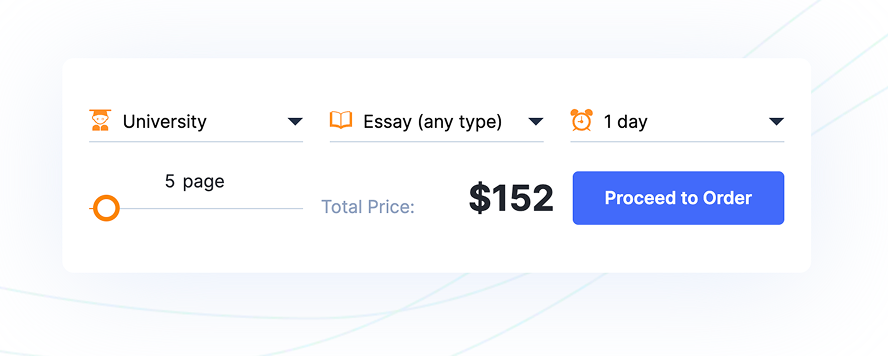
Scenario A – Rush Order
- Deadline: 1 day
- Instructions: minimal, almost vague
- Approach: “just get it done”
The goal here was simple – simulate what happens when a student is under pressure and submits the order without structure.
Scenario B – Planned Order
- Deadline: 14 days
- Instructions: detailed, structured
- Approach: controlled and intentional
This version reflects the opposite situation – when there is enough time to explain expectations clearly.
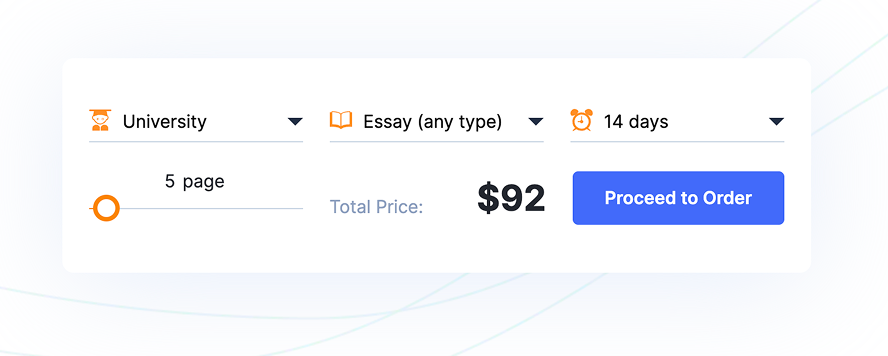
Before even placing the order, one detail stands out: the same essay costs $60 more simply because of time pressure. But price alone doesn’t explain outcome quality – it only sets the conditions.
14:05 – The Moment of Decision
Both orders were placed within minutes of each other.
The WriteMyPaperBro interface feels straightforward – no friction, no unnecessary steps, just a pricing calculator and a clear “Proceed to Order” button.
At this stage, the platform highlights something interesting:
- title page – included
- plagiarism report – included
- formatting – included
- revisions – included
All of this is presented as “free features,” with a total value of about $55.
At first glance, it feels like a strong deal.
But experience says otherwise – these features only matter if the writer actually uses them correctly.
14:12 – Two Orders, Two Mindsets
The difference between the two scenarios wasn’t technical – it was behavioral.
Rush Order Submission
The brief was intentionally weak:
- no clear structure
- no specific sources
- no formatting notes beyond “APA”
It looked like something a student would submit under stress – fast, incomplete, and slightly chaotic.
Planned Order Submission
The second order followed a completely different logic:
- clear thesis expectation
- paragraph structure outlined
- source requirements specified
- tone and academic level clarified
Same topic. Same service. Different input quality.
14:20 – Writer Assignment
Within minutes, both orders were assigned to writers from the WriteMyPaperBro pool.
This is where the system stops being predictable – and human variability takes over.
The two assigned writers:
- Jacob Alexander – 1300+ completed orders, strong analytics background
- Helen Werlam – 1600+ completed orders, specialization in biology and research-heavy content

At this point, both look equally reliable on paper:
- high ratings
- hundreds of reviews
- verified profiles
But profiles don’t write essays – execution does.
14:27 – First Messages
The first real signal of how the process will unfold appears in the initial communication.
Rush Order – First Interaction
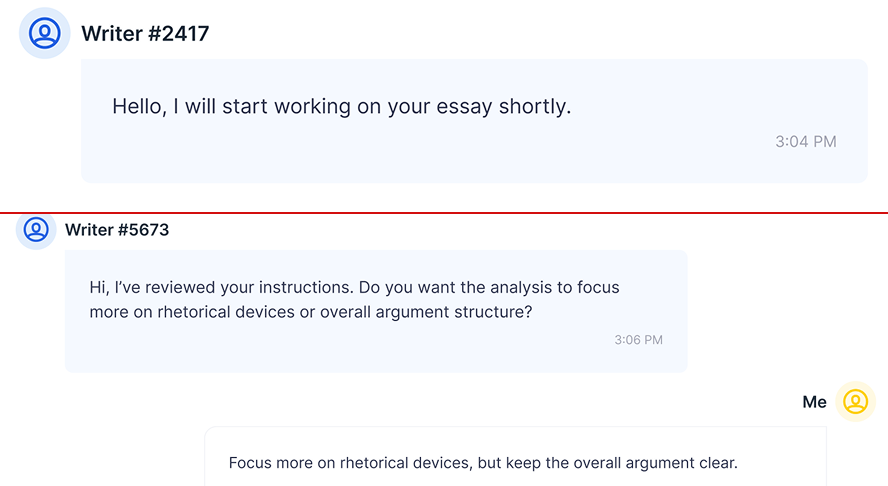
“Hello, I will start working on your essay shortly.”
No questions. No further details. No attempt to clarify the vague brief.
The writer accepted the task exactly as it was given.
Planned Order – First Interaction
“Hi, I’ve reviewed your instructions. Do you want the analysis to focus more on rhetorical devices or overall argument structure?”
This one small question changes the dynamic immediately.
- the writer engages with the task
- the brief becomes a conversation, not a static instruction
At this point – less than 30 minutes into the process – a pattern is already forming:
- the system behaves the same in both cases
- the writer behavior does not
And more importantly: a weak brief does not get corrected by the system – it gets executed as-is.
17:40 – Silence vs Signals
A few hours into the process, the difference between the two orders becomes less about what was submitted – and more about what is happening in the background.
Rush Order – No Signals
By 17:40, there were no updates, no messages, no visible progress indicators.
The order remained in “in progress” status, but that status doesn’t say much on its own.
At this point, I sent a quick message:
“Just checking – is everything on track?”
The reply came 22 minutes later:
“Yes, I am working on it.”
That was it.
- no details
- no outline preview
- no further details
The work might have been progressing – but from the outside, it felt like a black box.
Planned Order – Process Visibility
The second order behaved differently.
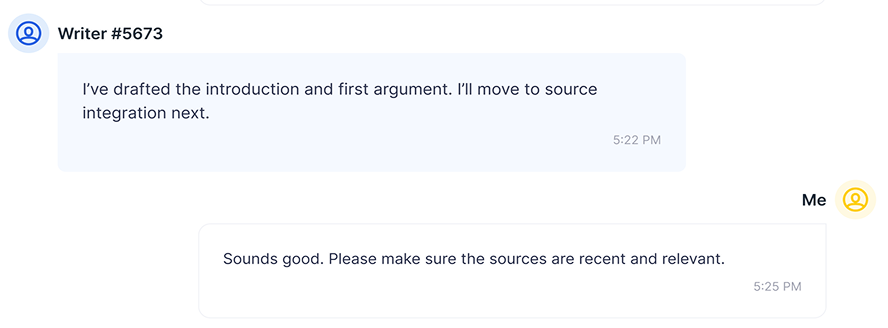
At 17:18, before I even reached out, the writer sent a short update:
“I’ve drafted the introduction and first argument. I’ll move to source integration next.”
This wasn’t just a message – it was a process signal.
- clear stage of work
- visible structure
- predictable next step
I replied with a small clarification about sources, and the writer adjusted direction immediately.
22:10 – Midway Reality Check
This is the moment where expectations start to form – and sometimes break.
Rush Order – Still No Structure
At 22:10, the rush order still showed no meaningful updates.
No outline. No partial draft. No further details.
At this point, I asked directly:
“Will the essay include academic sources?”
Response:
“Yes, I will include sources.”
The answer was technically correct – but informationally empty.
There was no indication of:
- what type of sources
- how many
- how they would be used
The process remained opaque.
Planned Order – Structure Already Visible
At roughly the same time, the second order had already moved forward.
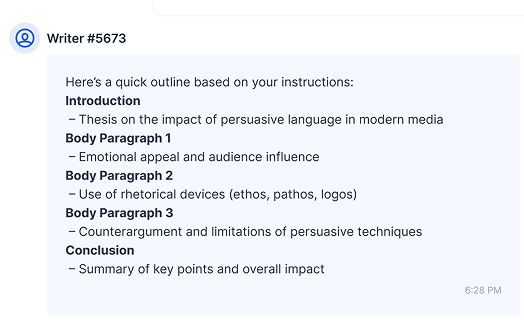
The writer shared a short outline:
- Introduction with thesis on persuasive language
- Body paragraph 1 – emotional appeal
- Body paragraph 2 – rhetorical devices
- Body paragraph 3 – counterargument
- Conclusion
This wasn’t requested – it was offered.
At this point, the difference is no longer subtle:
- one order is still undefined
- the other is already structured
Next Day 13:50 – Delivery Moment
Both essays arrived within the deadline window.
Technically, both writers delivered on time.
But delivery time is only the surface layer.
Rush Order – First Impression
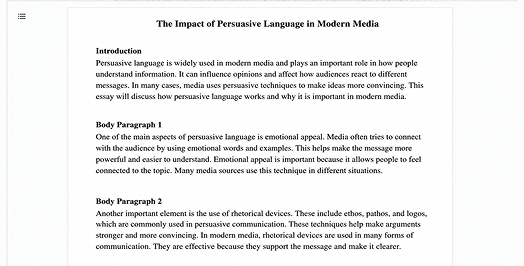
The document looked complete at first glance:
- 5 pages
- introduction, body, conclusion
- references included
But within the first few paragraphs, issues became visible:
- thesis was vague
- arguments overlapped
- transitions felt abrupt
Sources were present – but generic. Formatting existed – but not fully consistent.
Planned Order – First Impression
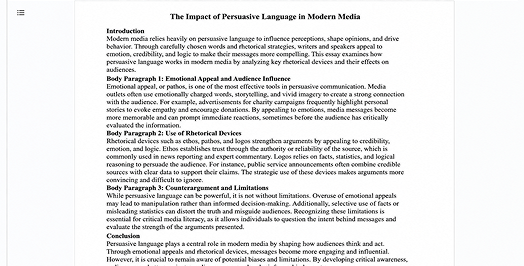
The second essay felt different immediately.
- clear thesis in introduction
- each paragraph followed a single idea
- sources were integrated into arguments
The structure matched the earlier outline almost exactly. Formatting was consistent. The text didn’t just “exist” – it held together.
14:30 – Revision Test: Can the System Fix a Weak Draft?
At this point, both essays were technically “done.”
But in real student behavior, this is rarely the final step.
Most papers get revised – either because something feels off, or because the requirements weren’t fully met.
So both orders received a revision request.
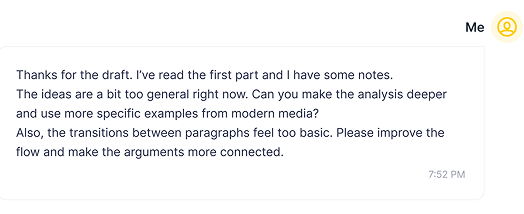
Revision Request (Same for Both)
- clarify thesis statement
- strengthen argument in second paragraph
- improve source integration
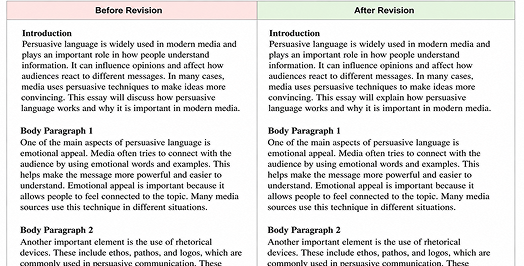
Rush Order – Revision Response
Reply time: ~1 hour
Message:
“I will revise and improve the essay.”
No further details. No questions.
The updated version arrived later that evening.
What Actually Changed
- thesis slightly reworded
- one sentence added to second paragraph
- references unchanged
At a glance, it looked “updated.”
But structurally, nothing really changed.
The same issues remained:
- arguments still overlap
- no deeper explanation
- sources still generic
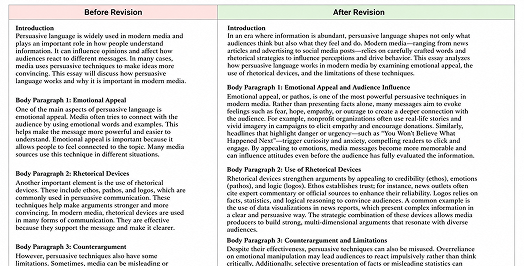
Planned Order – Revision Response
Reply time: ~20 minutes
Message:
“I’ll refine the thesis and expand the second argument. Do you want more academic sources added or just deeper explanation?”
The revision was delivered within a few hours.
What Actually Changed
- thesis rewritten with clearer focus
- second paragraph expanded with new reasoning
- additional source integrated into argument
This time, the difference was visible not just on the surface – but in the logic of the text.
What Actually Made the Difference
At first glance, it seems like the key variables were:
- deadline
- price
- writer profile
But after tracking the full process, a different pattern emerges.
It Was Not Just About Time
Yes, the 1-day order cost more.
Yes, the 14-day order allowed more flexibility.
But time alone did not define the outcome.
The Real Variables
- Input quality – vague vs structured brief
- Writer engagement – reactive vs proactive
- Process visibility – silence vs updates
These factors shaped the result far more than the platform itself.
The most important takeaway is not about quality.
It is about control.
In the rush scenario, the process was controlled by urgency.
In the planned scenario, the process was controlled by structure.
And that difference carried through every stage:
- communication
- writing
- revision
So… What Does WriteMyPaperBro Actually Feel Like?
It feels stable, predictable, and easy to use at the surface level.
But underneath, the experience depends heavily on how you approach the order.
If you submit a rushed request, the system will move fast – but not necessarily deep.
If you submit a structured request, the system becomes much more controlled and reliable.
In other words: WriteMyPaperBro does not define the outcome. Your input does.
FAQ
Does WriteMyPaperBro deliver good quality essays?
Yes, but quality is not uniform. In this test, both essays were technically complete, but only one showed strong structure and argument depth. The final result depends more on the writer and input quality than the platform itself.
Is there a big difference between a 1-day and a 14-day order?
Yes, both in price and outcome. The 1-day order cost $152, while the 14-day version cost $92 for the same essay. More importantly, longer deadlines allow better structure, communication, and overall quality.
Do “free features” actually improve the paper?
They help, but they are not a guarantee. Formatting, plagiarism reports, and revisions are included, but their effectiveness depends on how carefully the writer applies them.
How useful are revisions on WriteMyPaperBro?
Revisions work as a tool, not as a fix-all solution. In this test, one writer improved the structure significantly, while the other made only surface-level edits. The system allows revisions, but does not control their depth.
What is the biggest risk when ordering?
The main risk is relying on a weak brief or rushing the order. The platform executes what you submit – it does not refine unclear instructions. If the input is vague, the result will likely reflect that.
Comments are closed.