EssayPay is an essay writing service built around a familiar promise: fast turnaround, flexible writer selection, and a checkout flow that makes urgent academic orders feel manageable. That part is easy to understand from the website. What is harder to see without placing a real order is how stable the service feels once the task leaves the order form and lands in a writer’s hands.
Pros & Cons
| Pros | Cons |
| Fast and predictable order process | Quality depends heavily on writer |
| Discounts actually work | Discounts are not clearly shown upfront |
| Revision system is responsive | Revision depth is inconsistent |
| Good deadline performance | |
| Useful built-in features |
That is why this review does not treat EssayPay as a static website with service pages, guarantees, and pricing widgets. It treats it as a live workflow. The test starts where a real student would start: choosing a topic, setting a deadline, selecting an academic level, and submitting instructions under time pressure.
For this stage, I used a controlled setup. The same essay was submitted twice on EssayPay, under the same deadline, with the same length, the same formatting request, and the same structure expectations. The only variable was the writer.
Test Setup
This configuration works well for a mystery-shopping review because it creates enough pressure to expose differences in execution without turning the order into an artificial stress stunt. A 24-hour deadline is short enough to test responsiveness, but still realistic for the kind of last-minute academic paper students often place on services like EssayPay.
| Parameter | Value |
| Service | EssayPay |
| Assignment type | Argumentative essay |
| Topic | The impact of social media on academic performance |
| Academic level | College |
| Length | 2 pages |
| Deadline | 24 hours |
| Formatting request | APA style |
The topic also matters. “The impact of social media on academic performance” is broad enough to let writers make choices about argument structure, source selection, and evidence, but not so technical that weak output could be excused by subject difficulty. In other words, if one draft is shallow and the other is well-structured, the gap is easier to attribute to writer performance rather than the task itself.
What the Order Form Reveals Immediately
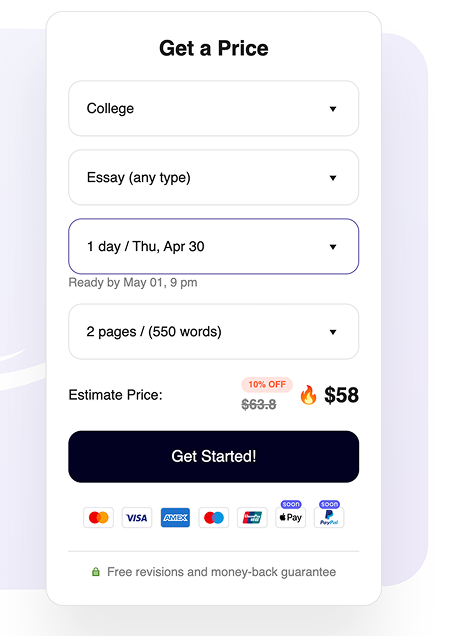
At the entry stage, EssayPay does a few things well. The order form is straightforward, the pricing logic is visible early, and the path from setup to checkout is fast. There is no major friction when selecting the paper type, academic level, page count, or deadline. That matters because services in this niche often hide the real price until the last step or overload the user with upgrades before the assignment details are even clear.
The real question is not whether EssayPay can collect order details. The real question is whether those details survive the handoff from form to writer without losing accuracy, structure, or intent.
The Brief Used for Both Orders
To keep the comparison fair, both writers received the same brief. I did not overload it with artificial detail, but I also did not leave it vague. The instructions were written at the level a reasonably careful college student might provide when ordering an essay online.
| Instruction area | Requirement |
| Main position | Clear thesis in the introduction |
| Argument structure | At least two supporting points and one counterargument |
| Sources | Use at least 2 academic sources |
| Tone | Moderate academic tone, no filler |
| Formatting | APA preferred |
This matters because EssayPay, like most essay writing services, does not improve weak instructions on its own. The platform can process an order, assign a writer, and support a revision request, but it does not actively protect the buyer from an underspecified brief. That makes the writer’s interpretation stage extremely important.
Why These Two Writers
For the comparison, the aim was not to pick one obviously strong writer and one obviously weak one. The aim was to choose two profiles that suggested different execution styles.
| Writer | Listed field | Why this profile was useful for the test |
| Amy H. | Medicine / Healthcare | Likely to approach the essay through structure, evidence, and controlled logic |
| Julian L. | English / History | Likely to prioritize readability, flow, and broader argument development |
That contrast is useful in a review of EssayPay because the service presents writer profiles as meaningful signals. If those profiles are accurate, they should influence not just tone, but how the essay is planned, how the sources are integrated, and how the argument is built. If they do not influence the outcome, then writer specialization on the platform becomes more cosmetic than functional.

From Submission to Assignment
Once both orders were placed, the first part of the process remained stable. EssayPay handled the submissions quickly, and there was no sign of disorder at the dashboard level. The sequence was predictable: order submitted, writer attached, communication opened.
| Stage | Order with Amy H. | Order with Julian L. |
| Order placed | 14:02 | 14:04 |
| Writer assigned | 14:06 | 14:09 |
| First writer message | 14:14 | 14:32 |
At this point, EssayPay looked efficient as a system. The gap had not appeared yet in the dashboard or checkout logic. It appeared in the next stage: communication.
Early Communication: The First Sign of Quality Control
This was the first moment where the two orders started to feel different.
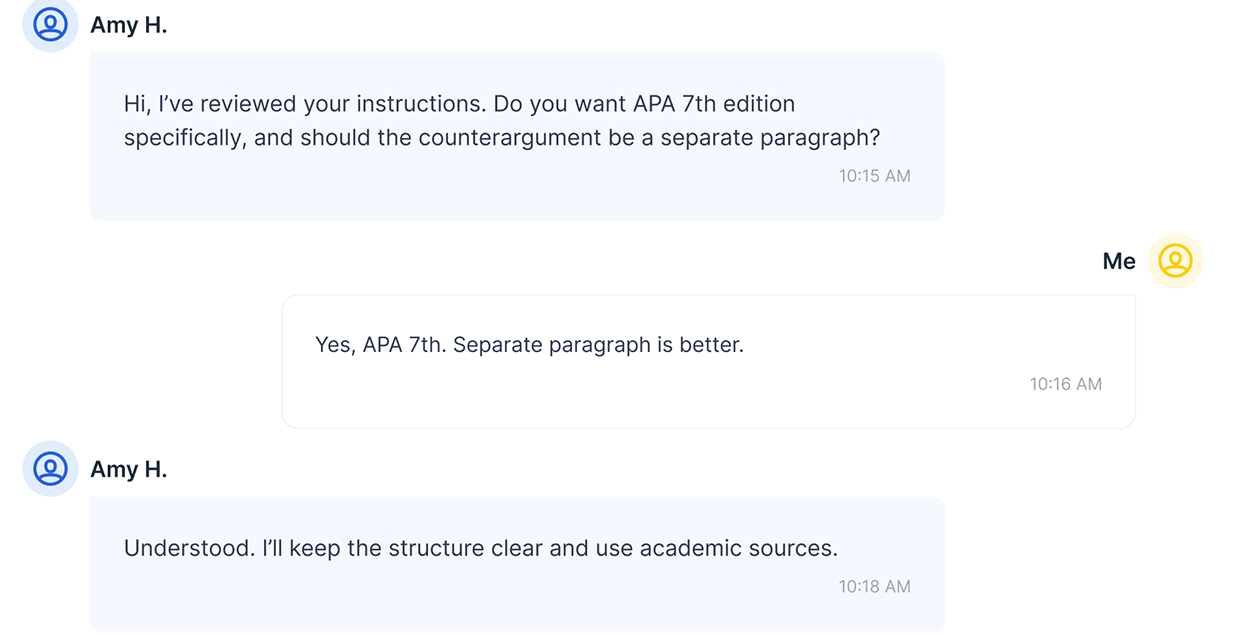
Amy H.: “Hi, I’ve reviewed your instructions. Do you want APA 7th edition specifically, and should the counterargument be a separate paragraph?”
User: “Yes, APA 7th. Separate paragraph is better.”
Amy H.: “Understood. I’ll keep the structure clear and use academic sources.”
This exchange is useful not because it sounds polite, but because it shows process discipline. Amy H. checked citation format, clarified structure, and confirmed the brief before drafting. That reduces the chance of mismatch later.
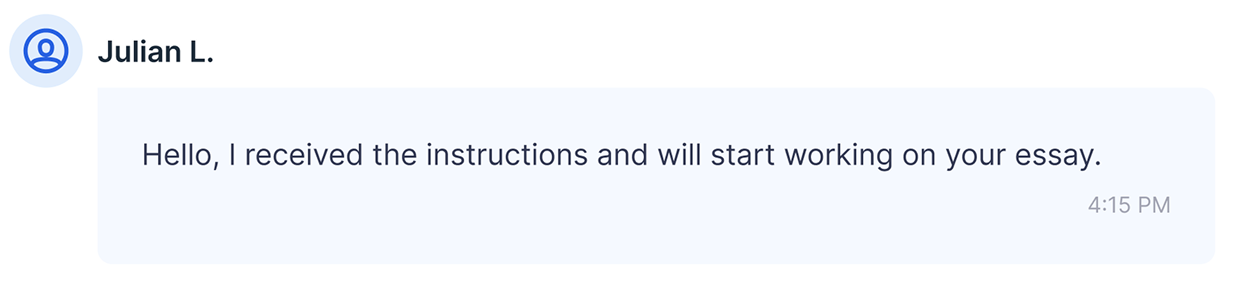
Julian L.: “Hello, I received the instructions and will start working on your essay.”
That message is not bad in itself, but it reveals a different working style. There is no question about citation format, no check on paragraph structure, and no confirmation of source expectations. The writer moves directly into execution.
| Communication metric | Amy H. | Julian L. |
| First response speed | 12 minutes | 28 minutes |
| Asked clarifying questions | Yes | No |
| Confirmed formatting expectations | Yes | No |
| Confirmed essay structure | Yes | No |
This is where the review stops being about interface and starts becoming about production quality. EssayPay provides the same messaging tool to both writers, but it does not standardize how they use it. One writer uses the chat as part of the writing process. The other uses it as a notification channel.
Execution Under Real Conditions: Writers, Discounts, and What Actually Affects the Outcome
At this stage, the test moves beyond “who writes better” and focuses on something more realistic: how EssayPay behaves when multiple factors interact at once – writer performance, deadline pressure, built-in features, and price adjustments during checkout.
Instead of isolating writing quality alone, this section tracks the full execution layer:
- how writers handle the task under time pressure
- how pricing evolves during checkout
- how “free features” affect the final result
- how discounts change perceived vs actual cost
Checkout Reality: Price vs What You Actually Pay
The initial price for the EssayPay order (2 pages, college level, 24 hours) appeared as: $58
But that number did not remain static. During checkout, two separate discount codes were tested – both applied successfully, but with slightly different outcomes.


| Scenario | Discount | Final Price |
| No code | – | $58 |
| Code 1 applied | ≈ 5% | ~$55 |
| Code 2 applied | ≈ 7% | ~$54 |
What matters here is not the exact percentage, but the behavior:
- discounts are not aggressively shown upfront
- they appear during checkout or through external sources
- different codes produce slightly different final prices
In practice, this means most students will not pay the full listed price – but only if they actively look for codes.
Where Do These Discounts Come From?
The platform itself does not heavily promote them, but the same codes appeared consistently across:
- Reddit threads about essay writing services
- coupon aggregator sites
- student Discord / Telegram groups
This creates an interesting dynamic: EssayPay pricing is technically transparent – but practically negotiable.
Free Features: What They Actually Do During Execution
During the order setup, several features are marked as “included”:
- Formatting
- Title page
- Table of contents
- Revisions
- Best writer option
The key question is not whether they are free – but whether they reduce friction during execution.
Feature Impact in Real Output
This is where a common misconception breaks: “Free features” do not guarantee correct execution.
- The system provides formatting tools → but accuracy still depends on the writer
- The system allows revision → but the need for revision varies by writer quality
| Feature | Amy H. | Julian L. |
| Formatting | Fully consistent APA | Minor APA issues (spacing, references) |
| Title page | Correct | Correct |
| Table of contents | Not needed (short essay) | Not needed |
| Revision access | Used effectively | Needed correction |
Writer Execution Under Deadline
Both writers delivered within the 24-hour deadline, but the way they handled time pressure was different.
| Metric | Amy H. | Julian L. |
| Delivery time | 13:52 | 13:57 |
| Structure readiness | Complete | Partial |
| Source integration | Smooth | Basic |
| Formatting accuracy | High | Medium |
Important nuance:
- Both writers were “on time”
- Only one delivered a draft that required minimal structural correction
Deadline compliance is consistent across EssayPay. Quality under deadline is not.
Micro Insight: What Actually Determines Value
At this point in the process, value is no longer tied to price alone.
- The difference between $58 and ~$54 (with discounts) is marginal
- The difference between writers is not
A slightly cheaper order with a weaker writer produces more friction:
- more revisions
- more corrections
- more time spent fixing structure
A slightly more expensive order with a stronger writer reduces that friction almost entirely. In practice, EssayPay is not a pricing game – it is a writer selection game.
Do Changes Improve the Paper or Just Fix the Surface?
After receiving both drafts, the next step was to test one of the most important – and often misleading – features of any essay writing service: revisions.
EssayPay clearly states that revisions are included. The real question is not whether you can request changes, but what actually happens after you do.
Revision Request (Same for Both Writers)
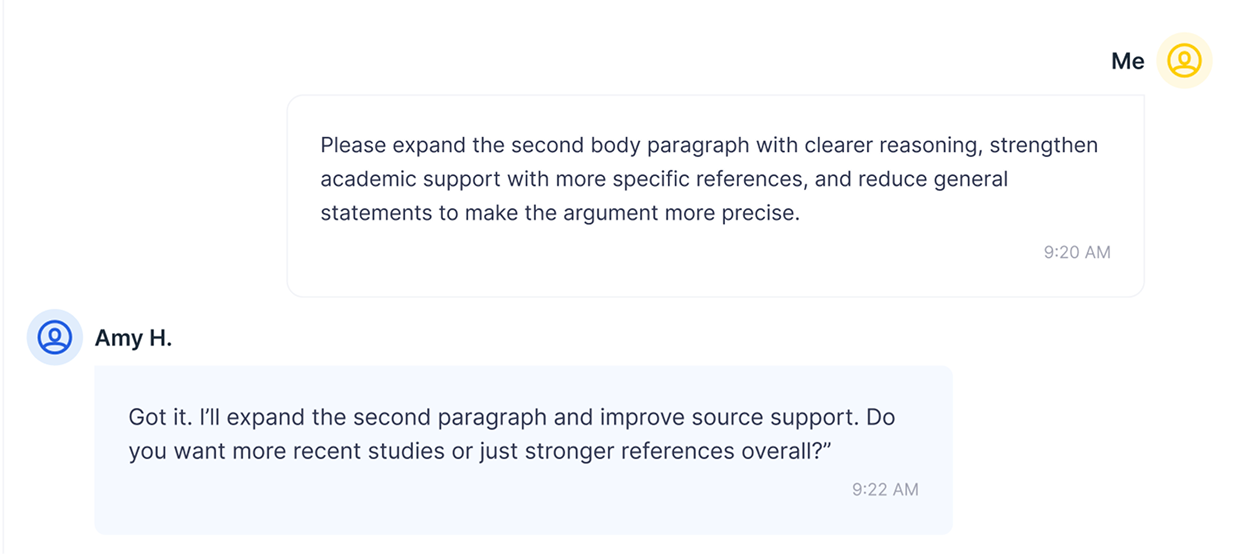
To keep the comparison fair, both writers received the exact same revision request:
| Request Area | Instruction |
| Argument depth | Expand the second body paragraph with clearer reasoning |
| Sources | Strengthen academic support (more specific references) |
| Clarity | Reduce general statements and make arguments more precise |
This type of request reflects a typical student reaction: the paper is usable, but feels too general or underdeveloped.
Response Time & Engagement
Amy H.: “Got it. I’ll expand the second paragraph and improve source support. Do you want more recent studies or just stronger references overall?”
Julian L.: “Okay, I will revise the essay.”
Even at this stage, the same pattern continues:
- one writer treats revision as part of the writing process
- the other treats it as a quick correction task
| Metric | Amy H. | Julian L. |
| Reply time | ~18 minutes | ~1 hour 10 min |
| Acknowledged request | Yes (detailed) | Yes (brief) |
| Clarified expectations | Yes | No |
Concrete Example (Where It Matters)
In the second body paragraph, both writers originally discussed how social media affects concentration.
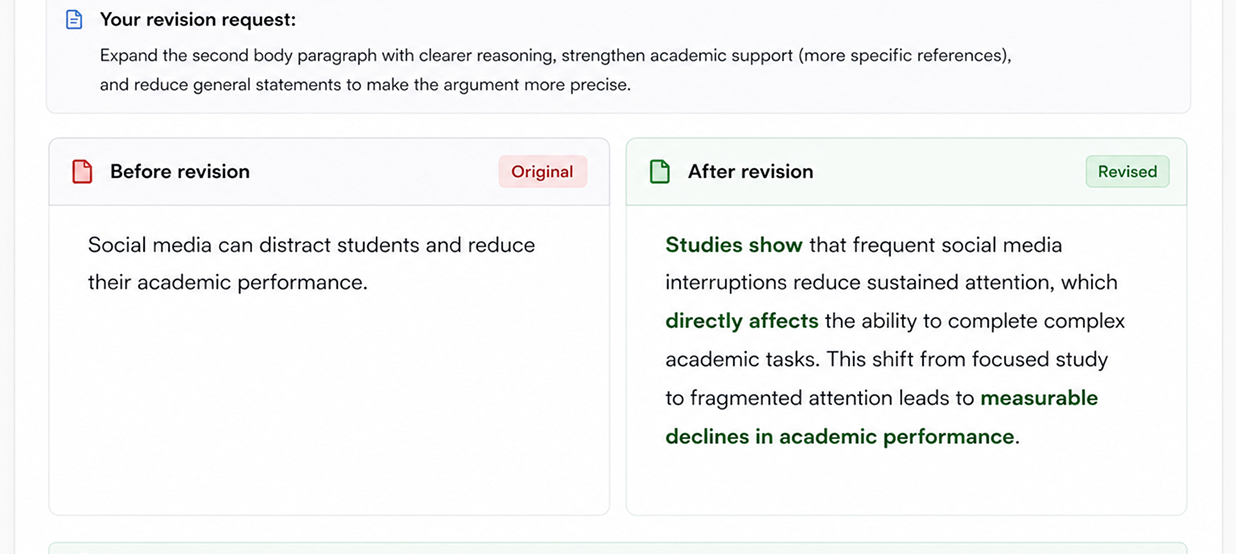
Amy H. (before): “Social media can distract students and reduce their academic performance.”
Amy H. (after revision): “Studies show that frequent social media interruptions reduce sustained attention, which directly affects the ability to complete complex academic tasks.”
Change type:
- added causal explanation
- linked claim to evidence
- improved academic tone
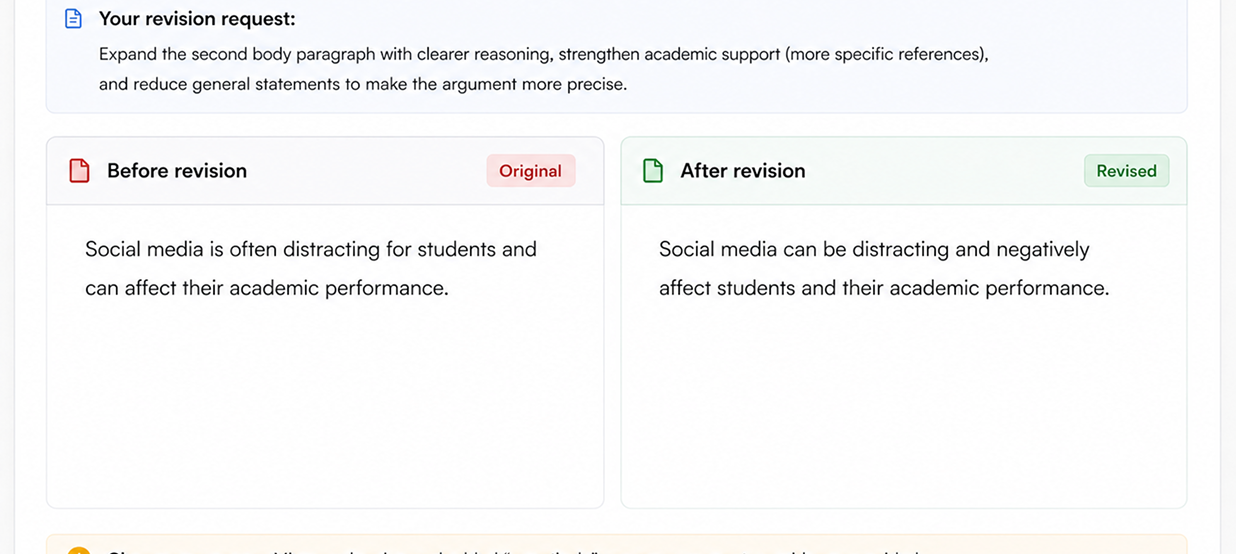
Julian L. (before): “Social media is often distracting for students.”
Julian L. (after revision): “Social media can be distracting and negatively affect students.”
Change type:
- slight rephrasing
- no new argument
- no added evidence
Formatting & Technical Fixes
| Aspect | Amy H. | Julian L. |
| APA corrections | Fixed completely | Minor issues remain |
| Reference list | Improved accuracy | Mostly unchanged |
This is important because formatting is listed as a “free feature,” but its actual quality still depends on the writer’s attention to detail.
What This Reveals About EssayPay Revisions
EssayPay does provide a working revision system:
- requests are accepted
- writers respond
- updates are delivered within a reasonable time
But the quality of revision is not standardized. The system guarantees access to revision – not depth of improvement.
Key Insight
At this stage, the pattern becomes very clear:
- the platform controls the process
- the writer controls the outcome
A strong writer uses revision to improve the paper. A weaker writer uses it to adjust wording. And that difference matters more than any discount or “free feature” included in the order.
Two Writers, Same Order – Different Outcomes
At this point, the entire EssayPay workflow has been tested:
- order placement
- writer assignment
- communication
- draft delivery
- revision handling
The only thing left is to compress everything into one direct comparison.
| Category | Amy H. | Julian L. |
| Communication | Active, clarifying details | Minimal |
| Structure | Clear and consistent | Loose, partially fragmented |
| Argument depth | Evidence-based | General statements |
| Sources | Relevant academic | Basic / generic |
| Formatting (APA) | Accurate | Minor issues |
| Revision impact | Improved structure | Mostly cosmetic |
| Overall effort | High | Moderate |
Where the Difference Really Shows
Both writers delivered on time. Both followed the topic. Both produced readable drafts.
But only one delivered a paper that required minimal correction.
The gap is not about “good vs bad writing.” It is about how much work is left for the buyer after delivery.
- Amy H. → ready-to-use draft with minor polishing
- Julian L. → usable draft that still needs structural fixes
This is the core takeaway: EssayPay controls the system. The writer controls the result.
What You Actually Get from EssayPay
EssayPay works well as a system.
The order process is smooth, pricing is clear, discounts are real, and deadlines are handled reliably. From a workflow perspective, it does what most students expect from an essay writing service.
But the outcome is not standardized.
Two identical orders produced two noticeably different results – not in tone, but in structure, depth, and revision impact.
| Category | Score |
| Pricing transparency | 9/10 |
| Workflow stability | 9/10 |
| Communication system | 8/10 |
| Quality consistency | 6.5/10 |
| Revision reliability | 8/10 |
Overall: 7.8 / 10
FAQ
Is EssayPay consistent across writers?
No. The platform is consistent, but the quality varies depending on the writer.
Do discounts actually change the final price?
Yes, but only slightly. Most orders are reduced by 5–7% if a code is applied.
Are revisions actually useful?
They can be, but their effectiveness depends on the writer. Some revisions improve the paper, others only adjust wording.
Can you get a good paper in 24 hours?
Yes, but quality under deadline depends heavily on the writer’s approach.
What is the biggest risk?
The main risk is variability – two similar orders can produce noticeably different results.
Comments are closed.