That is the same 5-page college essay priced two very different ways. The gap is $54, or about a 60% increase, created by one factor only: urgency. No upgrade box. No visible expert tier. No option to hand-pick a stronger writer. Just less time – and a much higher total.
$90 → 7 days
$144 → 24 hours
Quick Pros & Trade-Offs
| What Works Well | What to Watch Out For |
| Reliable delivery across different deadlines | Price increases faster than quality improves |
| Clean, frictionless ordering process | No visibility into writer selection |
| Revisions handled without resistance | Results depend heavily on your instructions |
| Consistent, safe academic output | Limited depth and originality |
Same order. Same 5-page college essay. Same instructions. One change – deadline.
The difference is $54. That’s a +60% price increase without changing the assignment itself.
So the question is not “is this service good?” The real question is: What exactly do you get for that extra $54?
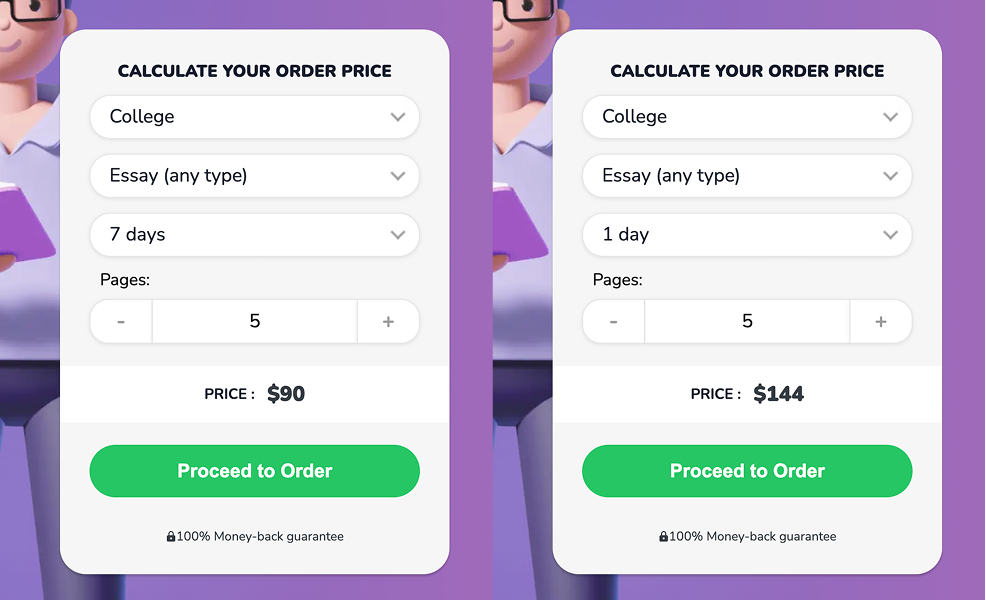
Order Setup – No Tricks, No Extra Help
I didn’t try to “optimize” the order.
No detailed outline. No uploaded files. No over-explained instructions.
Just a standard request:
- 5-page essay
- college level
- neutral topic
Why this matters:
- this is how most users actually order
- the system has to interpret the task on its own
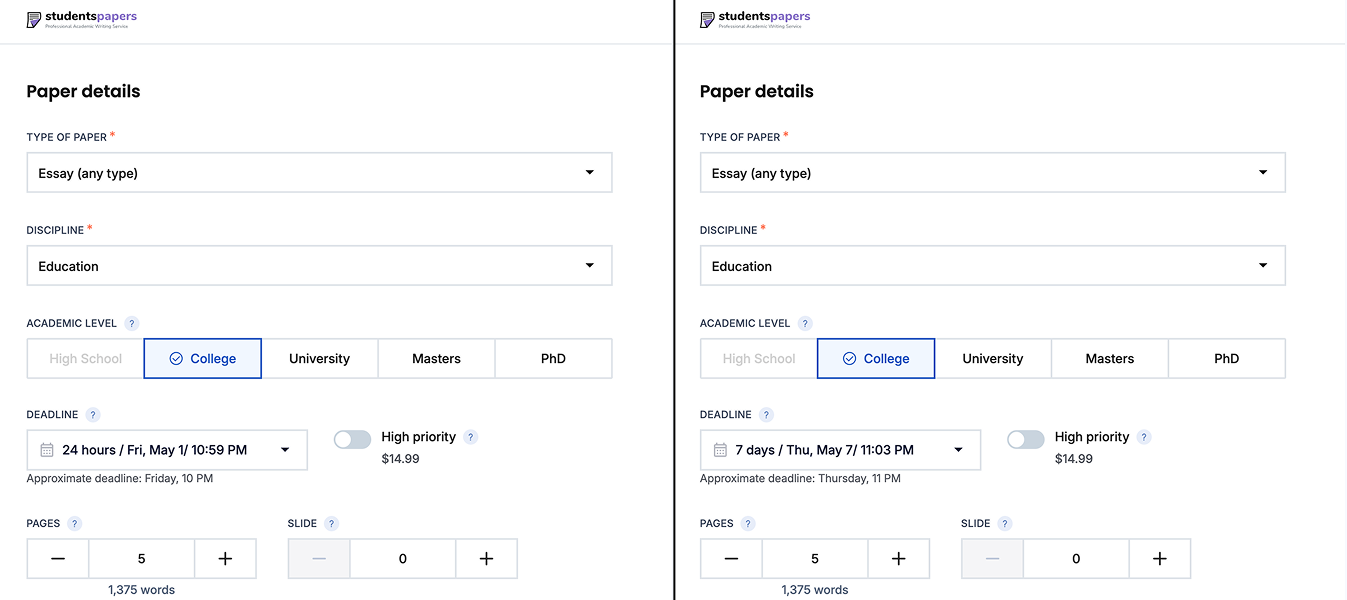
Then I duplicated the order.
- Order A → 7 days → $90
- Order B → 24 hours → $144
No other changes.
Interruption: if the output differs – it’s because of price pressure, not input quality.
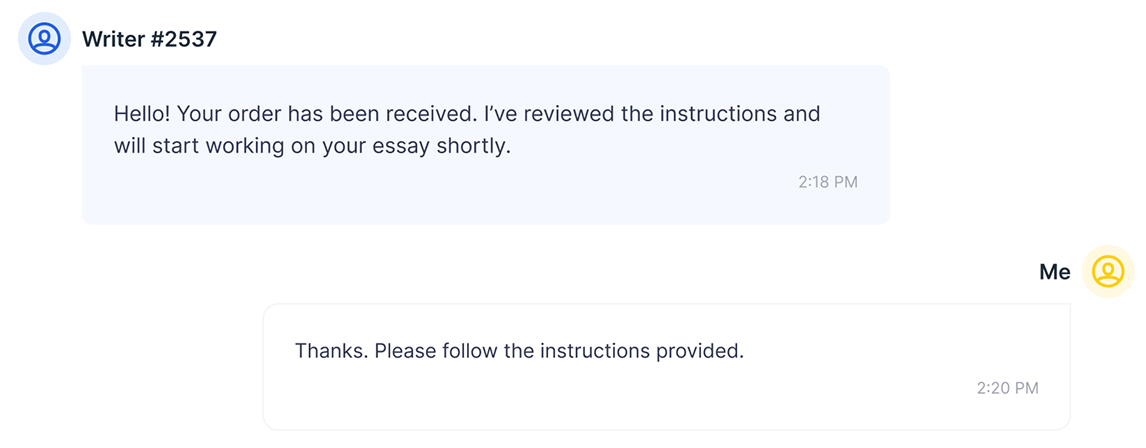
First Interaction – What Happens After You Pay
This is where things get interesting. After placing both orders, I expected at least one clarification message. Didn’t happen. Instead, the StudentsPapers system behaved like this:
- order accepted instantly
- no clarifying questions
- no request for additional details
Both orders moved forward without friction. That tells you something important:
the system assumes your instructions are “good enough” by default.
Now – the timing difference.
| Event | $90 Order (7 days) | $144 Order (24h) |
| Writer assigned | slower | faster |
| First message | delayed | slightly quicker |
| Message depth | basic | basic |
So yes – the expensive order moves faster. But the communication quality? Identical.
Field note: urgency affects speed, not engagement.
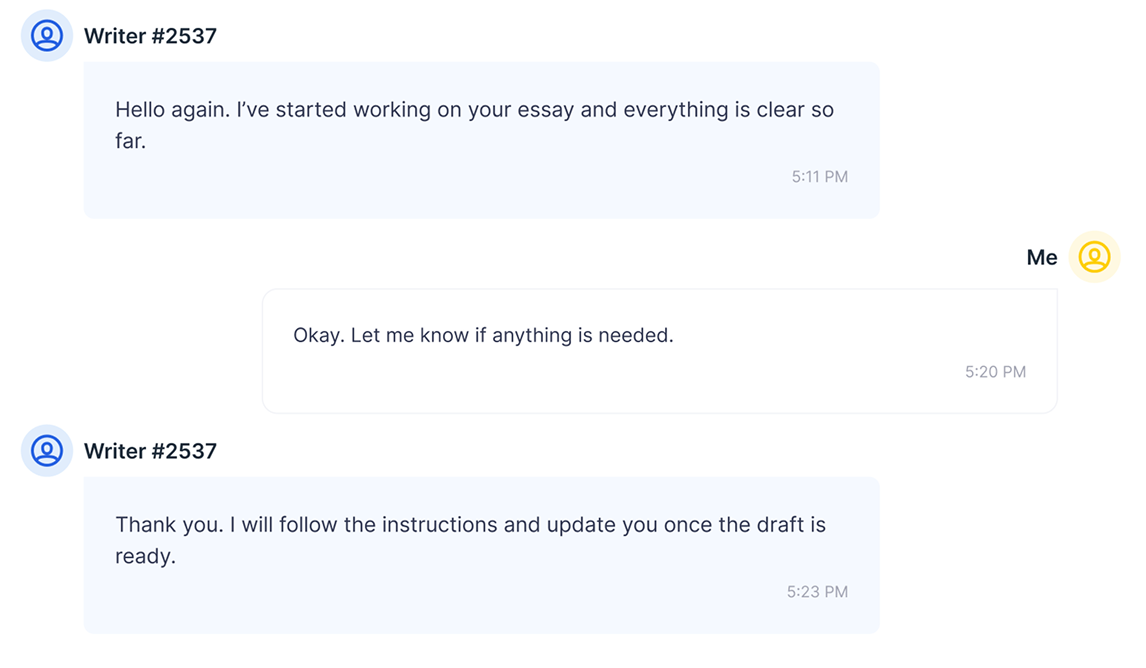
Writer Behavior – Small Signals That Matter
The difference between the two orders doesn’t appear in big things. It shows up in small details. For example:
- the urgent order responded slightly faster
- but didn’t ask better questions
- didn’t clarify the topic
- didn’t challenge the instructions
Both writers followed the same pattern:
- accept task
- confirm basic details
- move straight to writing
No deeper interaction. No attempt to refine the assignment. This is not necessarily bad. But it defines the system: execution-focused, not thinking-focused.
Interruption: you are not collaborating with a writer – you are feeding a process.
Draft Delivery – What $54 Actually Changes
Both orders were delivered on time.
- $90 order → delivered ~6 hours before deadline
- $144 order → delivered close to deadline (but on time)
That already breaks one common assumption. Cheaper does not mean slower delivery.
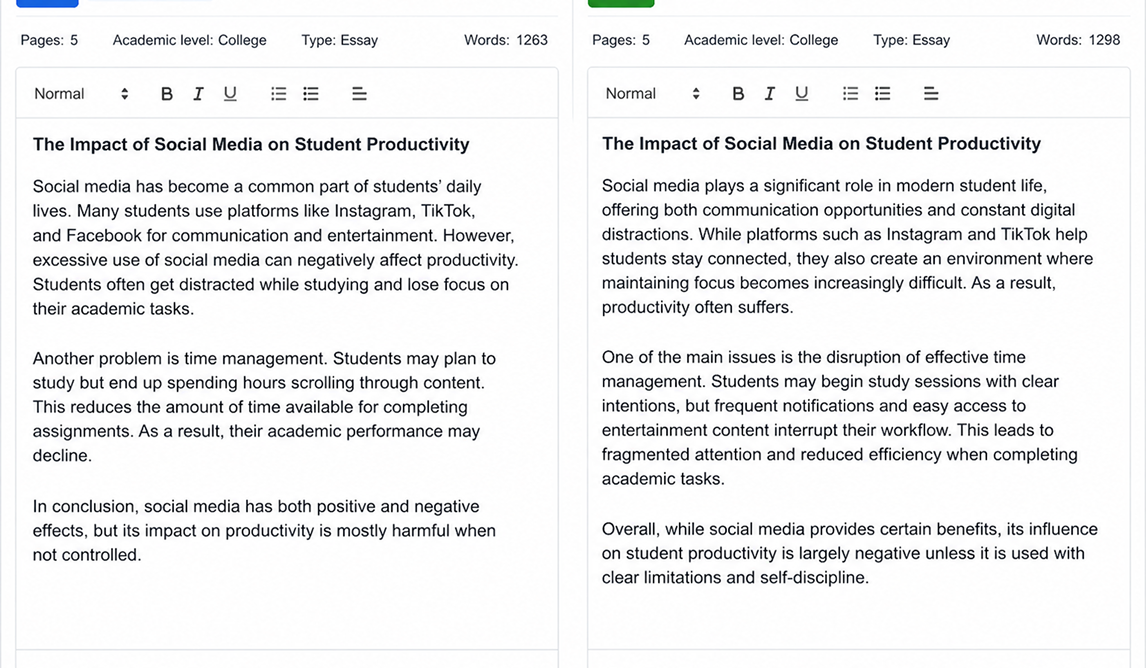
Now – the actual drafts. I compared them across four variables:
- structure
- argument depth
- sources
- writing control
| Factor | $90 (7 days) | $144 (24h) |
| Structure | clear but template-like | more connected paragraphs |
| Argument depth | basic development | slightly more layered |
| Sources | 4–5 standard references | 5–7, better integrated |
| Writing style | functional | cleaner transitions |
The difference exists. But it’s not proportional to the price jump.
+60% cost does NOT = +60% quality.
Field note: the expensive draft feels more “assembled,” not more “intelligent.”
Where the Expensive Order Actually Wins
The $144 version is better – but in very specific ways.
- cleaner paragraph transitions
- slightly stronger intro–body–conclusion flow
- sources connected to arguments (not just listed)
This creates one clear effect: less editing needed after delivery.
The cheaper version works. But it feels more like a draft you need to polish. The expensive version feels closer to a final submission.
Interruption: you’re paying for refinement, not for a higher level of thinking.
Where Both Versions Stay the Same
This is where the expectation gap becomes obvious.
Despite the price difference, both papers share the same limitations:
- no deep or original argument
- no strong academic voice
- safe, predictable structure
Neither draft goes beyond what you would expect from a standard academic template. No risk. No strong positioning. No “this stands out” moment. That tells you something critical: the system is optimized for reliability, not for depth.
Field note: both papers pass – neither one impresses.
Revision Test – What Actually Happens When You Ask for Changes
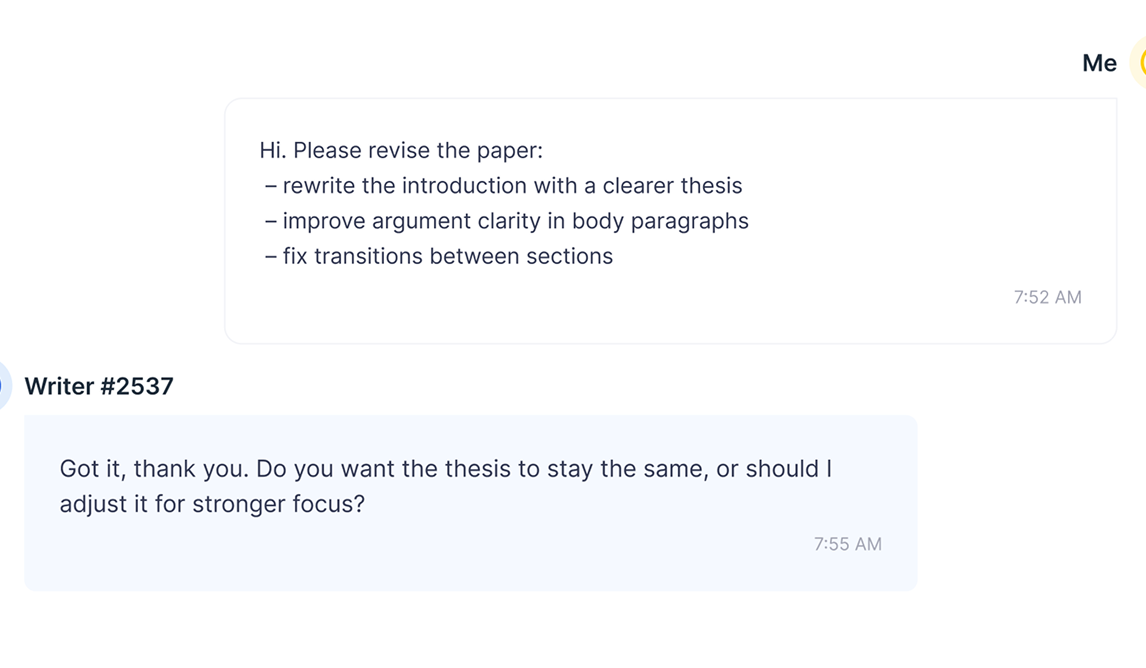
This is where the system starts to show its real behavior. Because writing a draft is one thing. Handling revisions is where quality either holds – or breaks. I sent both writers the same type of revision request:
- rewrite the introduction with a clearer thesis
- improve argument clarity in body paragraphs
- fix transitions between sections
No vague feedback. No “make it better.” Clear, structured instructions. Now – the interaction itself. The $90 order responded first with a short confirmation: “Got it. I will revise accordingly.” No follow-up.
The $144 order reacted slightly differently: “Do you want the thesis to stay the same or be adjusted?”
That’s a small detail. But it changes the entire revision dynamic. Interruption: one executes instructions – the other checks intent. Here is how the revision phase played out:
| Factor | $90 Order | $144 Order |
| Response time | ~2–3 hours | ~40–60 minutes |
| Clarification | none | minimal but present |
| Accuracy | partial (needed correction) | mostly aligned |
| Follow-up needed | yes | rarely |
The difference is not dramatic – but it is consistent.
The cheaper revision feels mechanical:
- changes are applied
- but not always interpreted correctly
- some parts need a second pass
The urgent revision feels more controlled:
- fewer misses
- better alignment with intent
- less need to explain things twice
Field note: revision quality depends less on writing skill – and more on how the system allocates attention.
Pricing Reality – What You’re Actually Paying For
At this point, the pattern is no longer theoretical.
It’s observable across the entire process:
- order speed
- writer response
- revision handling
The extra $54 does change the experience. But not in the way most users expect. Here is what actually improves:
- faster internal response (assignment + revisions)
- slightly cleaner structural execution
- better alignment during revision cycles
And here is what stays almost unchanged:
- depth of analysis
- originality of ideas
- visibility of writer expertise
That creates a very specific model.
Not a marketplace. Not a “choose your expert” system. A controlled workflow with priority layers. You are not upgrading the writer. You are upgrading how the system handles your task. Interruption: the price changes the attention you get – not the level of thinking.
Field note: the system upgrades polish before it upgrades substance.
A Small Detail That Changes the Final Price
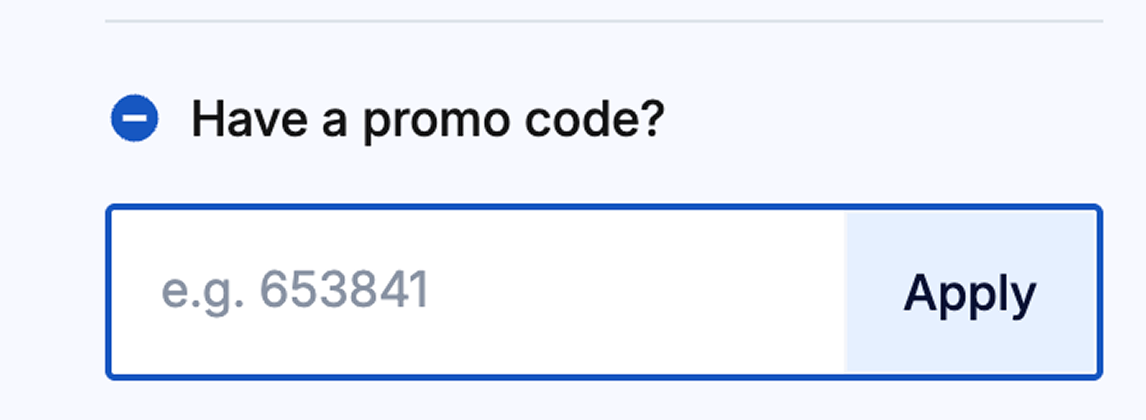
Right before confirming the urgent order, I almost paid the full $144. Then I paused. Quick check – promo codes exist. Applied one. The total dropped. Not dramatically, but enough to change the perception of urgency pricing.
Important detail:
- the platform does not actively push discounts
- you have to look for them yourself
This creates a small but useful advantage:
- urgency raises the base price instantly
- discounts can partially offset that – if you act before paying
Interruption: the fastest way to overpay is to rush the checkout.
Final Comparison – Side by Side
| Category | $90 (7 days) | $144 (24h) |
| Delivery | early | on time |
| Structure | basic | cleaner |
| Depth | standard | slightly better |
| Sources | acceptable | better integrated |
| Revisions | needs guidance | more accurate |
The takeaway is simple: the expensive version performs better – but within the same range.
Who This Service Actually Works For
This system works well if you:
- need a reliable draft under time pressure
- can review and slightly edit the result
- value consistency over uniqueness
It works less well if you expect:
- deep academic insight
- strong original argumentation
- visible control over writer expertise
Field note: this is a system you guide – not one that guides you.
Final Insight
The experiment started with a simple comparison:
- $90
- $144
And one question: does paying more actually improve the outcome? The answer is precise: Yes – but only at the surface level.
You get:
- better flow
- cleaner structure
- faster and more accurate revisions
You do not get:
- deeper thinking
- stronger academic voice
So the real conclusion is this: The system works. But it scales speed and polish – not depth. One more thing: If you know exactly what you want, this service delivers.
If you expect it to figure things out for you – it won’t.
FAQ
Does paying more on StudentsPapers improve quality?
It improves structure and refinement, but not dramatically. The main difference is in execution, not in depth.
Is the cheaper option good enough?
Yes – for standard assignments. But expect to do light editing if you want a more polished result.
Do you get a better writer with a higher price?
There is no visible writer selection, so the difference is not transparent. The system prioritizes speed rather than showing expertise levels.
Are revisions reliable?
Yes. Revisions are handled smoothly, but the outcome depends on how clearly you describe your request.
Can you reduce the price?
Sometimes – promo codes can lower the total, especially for urgent orders, but you need to apply them manually.
Comments are closed.